

Estimated Read Time– 12-15 minutes
Word Count- 1400-1450
Mutual Funds vs Stocks vs ETFs
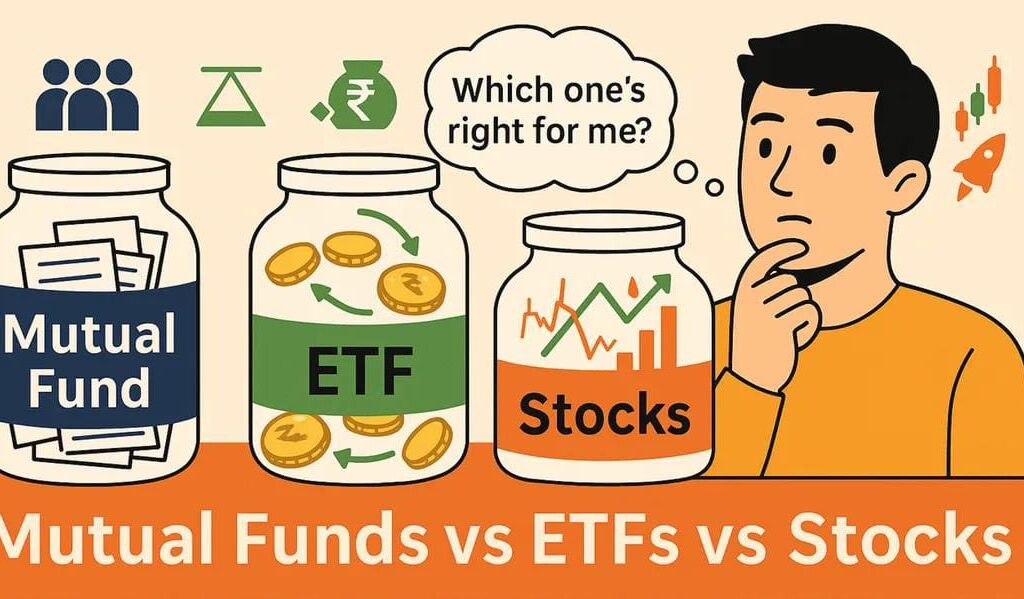
The 2025 Beginner’s Dilemma
Just imagine you’re 25 and you just started your first job and have ₹5,000 monthly to invest. Your college friend is bragging about his stock picks that “doubled in 6 months,” your cousin swears by her mutual fund SIPs, and your office colleague keeps talking about low-cost ETFs.
The burning question: Should you pick individual stocks, start SIPs in mutual funds, or invest in ETFs?
This isn’t just about returns—it’s about time, effort, risk tolerance, and building sustainable wealth. The wrong choice early can cost you years of compounding. By the end of this guide, you’ll have a clear framework to choose your investment path with confidence.
What Are These Investment Options Really?
Mutual Funds: Professional fund managers pool money from thousands of investors to buy a diversified portfolio of stocks, bonds, or other assets. You own units of the fund, not individual stocks. SIPs allow automated monthly investing starting from ₹500 (Association of Mutual Funds in India, 2025).
Stocks: Direct ownership shares in individual companies traded on stock exchanges. When you buy Reliance or Infosys shares, you become a partial owner with voting rights and dividend claims. Requires research, timing decisions, and portfolio management skills.
ETFs (Exchange Traded Funds): Basket of securities that track an index, sector, or commodity, traded on stock exchanges like individual stocks. Combines diversification of mutual funds with trading flexibility of stocks, typically with lower costs than actively managed funds (SEBI ETF Guidelines, 2025).
The Reality Check: What Each Actually Involves
Mutual Funds Journey
- Getting Started: Download any mutual fund app, complete KYC, start SIP
- Time Commitment: 15 minutes setup, 30 minutes quarterly review
- Decision Making: Choose fund category, set SIP amount, stay invested
- Ongoing Work: Monitor performance annually, rebalance if needed
Stock Investing Journey
- Getting Started: Open demat account, learn financial statement analysis
- Time Commitment: 2-4 hours weekly for research and monitoring
- Decision Making: Company selection, entry/exit timing, portfolio allocation
- Ongoing Work: Track results, read annual reports, follow news
ETF Investing Journey
- Getting Started: Open demat account, understand index tracking
- Time Commitment: 1 hour setup, 1 hour monthly monitoring
- Decision Making: Choose index/sector exposure, timing purchases
- Ongoing Work: Track index performance, rebalance occasionally
Real Case Study: Three Friends, Three Paths (2020-2025)
Let’s follow three 24-year-olds who started investing ₹8,000 monthly in January 2020 with different approaches.
Rahul: Mutual Fund SIP Investor
- Strategy: ₹8,000 monthly SIP in Axis Bluechip Fund
- Approach: Set auto-debit, never stopped during COVID crash
- Time Spent: 2 hours total over 5 years
- Behavior: Ignored daily market fluctuations, stayed disciplined
Rahul’s Results (Jan 2020 – Sep 2025):
- Total Invested: ₹5,36,000 (67 months)
- Portfolio Value: ₹7,45,000
- Returns: 11.8% CAGR
- Stress Level: Minimal
Priya: Direct Stock Investor
- Strategy: Researched and bought 12 large-cap stocks
- Approach: Studied annual reports, tracked quarterly results
- Time Spent: 3-4 hours weekly on research
- Behavior: Panic-sold some stocks during COVID, bought others
Priya’s Results (Jan 2020 – Sep 2025):
- Total Invested: ₹5,36,000
- Portfolio Value: ₹8,65,000
- Returns: 15.6% CAGR
- Stress Level: High during volatility
Arjun: ETF Investor
- Strategy: Monthly investment in Nifty 50 ETF
- Approach: Simple index tracking with low costs
- Time Spent: 1 hour monthly
- Behavior: Consistent investing, occasional rebalancing
Arjun’s Results (Jan 2020 – Sep 2025):
- Total Invested: ₹5,36,000
- Portfolio Value: ₹7,20,000
- Returns: 10.9% CAGR
- Stress Level: Low to moderate
The Insight: Priya earned the highest returns but invested 15x more time and stress than Rahul. Arjun got market returns with minimal effort but slightly lower returns than active management.
Your Complete Decision Framework
Factor 1: Time Availability Reality Check
Weekly Time Investment Required:
- Mutual Funds: 30 minutes monthly (fund selection, SIP monitoring)
- ETFs: 1 hour monthly (index tracking, rebalancing)
- Stocks: 3-5 hours weekly (research, analysis, monitoring)
Decision Rule:
- <1 hour/week: Mutual fund SIPs are your best option
- 1-2 hours/week: ETFs offer good balance of control and simplicity
- >3 hours/week + enjoy research: Direct stocks become viable
Factor 2: Knowledge and Skill Assessment
Basic Skills Needed:
- Mutual Funds: Understand fund categories, expense ratios, SIP concept
- ETFs: Index concepts, tracking errors, bid-ask spreads
- Stocks: Financial statement analysis, valuation ratios, industry dynamics
Learning Curve:
- Mutual Funds: 2-3 days to understand basics
- ETFs: 1-2 weeks to grasp index investing
- Stocks: 3-6 months minimum for basic competence
Decision Rule:
- Beginner to finance: Start with mutual funds
- Some financial knowledge: ETFs are efficient learning ground
- Strong analytical skills: Consider direct stocks with proper limits
Factor 3: Cost Analysis (The Hidden Wealth Killer)
Annual Cost Comparison (₹1 lakh investment):
- Mutual Funds: ₹1,500-2,000 (1.5-2% expense ratio)
- ETFs: ₹300-500 (0.3-0.5% expense ratio) + brokerage
- Stocks: ₹500-800 (brokerage + taxes, assuming reasonable trading)
10-Year Impact: On ₹10 lakh corpus, high-cost funds can reduce wealth by ₹2-3 lakh compared to low-cost alternatives (Morningstar India Cost Study, 2024).
Factor 4: Risk Tolerance and Diversification
Risk Profile:
- Mutual Funds: Moderate (instant diversification across 30-100 stocks)
- ETFs: Moderate to high (index-level diversification, market timing risk)
- Stocks: High (concentration risk, individual company failures)
Minimum Portfolio Size for Adequate Diversification:
- Mutual Funds: ₹500 (built-in diversification)
- ETFs: ₹5,000-10,000 (single ETF covers entire index)
- Stocks: ₹5-10 lakh (12-15 stocks across sectors for proper diversification)
Your Step-by-Step Action Plan
Self-Assessment
- Time audit: Honestly assess weekly hours available for investing
- Knowledge check: Rate your financial literacy on a 1-10 scale
- Risk profiling: Use online risk assessment tools
- Goal clarity: Define investment timeline and objectives
Platform Setup
- Mutual Funds: Download apps like Coin, Kuvera, or direct AMC platforms
- ETFs/Stocks: Open demat account with discount brokers (Zerodha, Groww, Upstox)
- Complete KYC: Submit required documents for account activation
- Link bank account: Set up auto-debit for systematic investing
Product Selection
- Mutual Funds: Choose 2-3 funds across large-cap, flexi-cap, and debt categories
- ETFs: Select broad market index ETF (Nifty 50) as starting point
- Stocks: If choosing this path, start with top 10 Nifty companies for learning
Implementation and Automation
- Start small: Begin with 50% of intended amount to test systems
- Set up automation: SIPs for mutual funds, calendar reminders for ETFs/stocks
- Track performance: Use portfolio tracking apps for monitoring
- Schedule reviews: Monthly for ETFs, quarterly for mutual funds
Decision Matrix: Choose Your Investment Path
Choose Mutual Funds If You:
- Have limited time for investment research
- Prefer professional management over DIY approach
- Want automated, disciplined investing through SIPs
- Are comfortable with moderate fees for convenience
- Seek steady, long-term wealth building
Go for ETFs If You:
- Want low-cost investing with index-level diversification
- Have basic understanding of market indices
- Prefer some control over timing and trading
- Can handle occasional manual intervention
- Seek market returns without active management fees
Choose Stocks If You:
- Enjoy researching companies and analyzing businesses
- Have 3+ hours weekly for investment activities
- Possess strong analytical and emotional discipline
- Have sufficient capital for proper diversification (₹5+ lakh)
- Seek potentially higher returns and accept higher risks
The Hybrid Approach: Best for Most Beginners
The 60-30-10 Portfolio:
- 60% Mutual Fund SIPs: Core stability through diversified funds
- 30% ETFs: Low-cost market exposure with some control
- 10% Individual Stocks: Learning ground for stock picking skills
Implementation Timeline:
- Months 1-6: Start with mutual fund SIPs only
- Months 7-12: Add ETF investments for experience
- Year 2+: Gradually introduce individual stocks as knowledge grows
Common Mistakes to Avoid
Mutual Fund Mistakes: Chasing last year’s top performers, frequent fund switching, not increasing SIP with income growth.
ETF Mistakes: Trading too frequently, ignoring tracking error, not understanding index composition.
Stock Mistakes: Concentrating on a few stocks, emotional buying/selling, ignoring fundamental analysis.
The Bottom Line: Start Simple, Evolve Smart
There’s no universal “best” choice among mutual funds, stocks, and ETFs. The optimal approach depends on your current knowledge, available time, and investment temperament.
For most beginners: Start with mutual fund SIPs to build the investing habit, then gradually explore ETFs and individual stocks as your knowledge and confidence grow.
Remember: Consistency beats complexity. A simple mutual fund SIP that you maintain for 15 years will likely outperform complex strategies that you abandon after 2 years.
The key is starting now with whatever approach fits your current situation, then evolving your strategy as you learn and grow.
Open your FREE Wealth Alpha account. Upload holdings once, get instant portfolio scores, AI‑driven optimization, and pro screeners in one place.
Sign up now: https://wealthalpha.in